
Automobile retail sales in India witnessed a double-digit year-on-year growth in February driven by robust sales across segments including passenger vehicles and two-wheelers, automobile dealers' body FADA said on Monday. Total registrations across segments rose 16 per cent year-on-year to 17,75,424 units last month, as compared to 15,31,196 vehicles in February 2022. Passenger vehicle retail sales rose 11 per cent to 287,182 units last month, against 258,736 units in the year-ago period.
Issues like high insurance cost and the announced price hike effective January could also weigh on sales in 2019. The only bright spot is the softening seen in fuel prices over the past month.

Maruti Suzuki India (MSIL) will hold discussions with the Centre and state governments on how the production of compressed biogas (CBG), which can be used in vehicles that run on compressed natural gas (CNG), can be expanded in the country, its majority shareholder Suzuki Motor Corporation (SMC) said. The demand for CNG vehicles has been rising significantly in the country. MSIL sold 145,000 CNG vehicles in the first quarter of 2024-25, marking a 28.3 per cent year-on-year (Y-o-Y) growth.

Traversing from being just vehicle manufacturers to mobility solutions providers amid a raging debate over which eco-friendly technology must be incentivised, the Indian automobile industry is driving in the new year under the shadow of a slowdown in sales with the post-pandemic pent-up demand in distant memory. The shift in the auto industry -- where advanced technologies like autonomous driving, vehicle intelligence, connected features and electrification are quickly gaining traction -- will be reflected in the upcoming Bharat Mobility Global Expo in which India's flagship Auto Expo has been clubbed to be held from January 17-22, 2025 in Delhi-NCR.

The muted expectation of dealers come at a time when vehicle manufacturers such as Maruti Suzuki, Hyundai Motor, Mahindra & Mahindra and others reported a double-digit fall in wholesale dispatches to dealerships in July and August.

Companies with "gas guzzlers" are trying to set up the wrong narrative against small cars getting relaxation in the proposed corporate average fuel efficiency (CAFE-III) norms on the basis of weight, Maruti Suzuki senior executive officer corporate affairs Rahul Bharti said on Monday, bringing to the fore deep division among carmakers regarding the upcoming rules.

Maruti Suzuki India on Tuesday said it has commenced export of its sports utility vehicle Fronx to Japan. The first consignment of over 1,600 vehicles left for Japan from Gujarat's Pipavav port, the country's largest carmaker said in a statement. Fronx will be the first SUV from Maruti Suzuki stable to be launched in Japan, it added.

The Indian automobile industry entered the big league as car sales touched 1.03 million units during 2003-04, notching an impressive 32 per growth.

Skoda Auto India, the Czech carmaker that has recently found success with its compact SUV Kylaq, says it remains committed to developing a fully localised electric vehicle (EV). The EV will be manufactured at its Chakan facility for both Indian market and exports.

According to experts, even if an additional 5 per cent of people opt to buy new vehicles, it may bring a huge boost to the sector.

Volkswagen Passenger Cars is targeting a volume sales growth of about 15 per cent in the country in 2024, even as it expects the Indian passenger vehicle (PV) industry to grow by 5-7 per cent in the current year, its India brand director, Ashish Gupta, said on Thursday. This means the company is expecting to grow 2-3 times faster than the Indian PV industry in 2024. But globally, the German automaker is expecting just 3 per cent rise in sales this year, down from 12 per cent last year.

India's macroeconomic health is in a "relative goldilocks situation", and although the risk of higher landed oil prices, due to insurance cost surges and closure of choke points due to the brief Israel-Iran war, has receded, it is "too soon to sound the 'all clear' for the rest of the year", the Finance Ministry said on Friday.
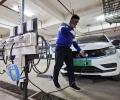
Even as the government debates whether to continue the FAME-II subsidy for electric vehicles (EVs), the share of such vehicles in overall sales is decelerating, after witnessing a heady growth in the first few years. The penetration of EVs - electric two-wheelers, passenger vehicles, three- wheelers and other segments collectively - in the first 10 months of FY24 has been pegged at 4.3 per cent, compared to 3.7 per cent in FY23, according to credit rating agency ICRA.

The new SUV from the Tatas will compete with the likes of Jeep Compass, Hyundai Creta, Hyundai Tucson and the Mahindra XUV500.

The key question is how much of the latest growth record represents recovery from the 2020-2021 downturn, and what is the sustainable growth rate now, asks T N Ninan.
Tata Motors on Tuesday reported a 44.5 per cent growth in sale in July at 45,056 units, (including exports) as compared to over 31,173 units in the same month last year.

'It is going to be as high as 50% in the coming one or two months and can be about 20% to 25% in the medium term.'

'Inquiries and bookings are at quite a healthy level.'

'In terms of incentives, if you think about it, hybrids are a 20-year-old technology.'

A Chinese firm this week began trial production of flying cars stated to be the next-generation in the world of transportation, ahead of US firm Tesla and others plans to launch the same shortly.

Tata Motors is looking to ramp up the production of electric vehicles as demand continues to outpace the manufacturing activity by a huge margin, according to a top company official. The Mumbai-based automaker, which led the passenger electric vehicle space in the domestic market in last fiscal year, has been receiving an average of 5,500-6,000 bookings in the past two months for its EV range. The company sells three electric products -- Nexon EV, Tigor EV and XPRES-T -- in the domestic market.

Tata Motors on Wednesday launched its Tiago EV with introductory prices for first 10,000 customers ranging between Rs 8.49-11.79 lakh
Passenger Vehicle sector seeks cut in excise duty on large cars too, and to reduce interest on auto loans to boost demand

Aided by robust festive season offtake, automobile retail sales in India witnessed a 48 per cent annual jump in October, automotive dealers' body Federation of Automobile Dealers Associations said on Monday. The total retail sales last month stood at 20,94,378 units, up 48 per cent from 14,18,726 registrations in October 2021. The registrations last month were even better by 8 per cent as against October 2019, a pre-COVID month. The festive season this year turned out to be the best for the industry in the last four years.

India's second-largest passenger vehicles firm will be valued at Rs 1.59 trillion at the top-end of the price band of Rs 1,865-Rs 1,960.

The crisis may not be as visible this time, but the stakes are just as high, points out Rajeswari Sengupta.

While commercial vehicle (CV) sales were the worst hit, down by 21 per cent to 67,793 units from 85,833 units, two-wheeler sales dropped by 16 per cent to 12,64,169 units from 15,00,545 units. Passenger car sales dropped nine per cent to 215,716 units from 236,586 units.
Automobile retail sales in India increased by 37 per cent in April on a low base of COVID-hit April last year, automobile dealers' body FADA said on Thursday. Total sales across categories rose to 16,27,975 units in April, as compared to 11,87,771 units in the year-ago period. On a year-on-year basis, all vehicle categories including passenger vehicles and two-wheelers were up as compared with April last year.

Auto majors, including Maruti Suzuki India, Hyundai and Tata Motors, on Sunday reported high double-digit growth in their domestic passenger vehicle sales in July riding on stabilisation of macro-economic factors and better consumer sentiments. Similarly, Honda, Nissan, MG Motor and Skoda also reported healthy growth in their sales last month leveraging on improved market mood amid prevailing lower coronavirus infection rate, despite supply constraints of semi-conductors. The country's largest carmaker Maruti Suzuki India's (MSI) domestic sales increased by 39 per cent to 1,41,238 units last month as against 1,01,307 units in July 2020, the company said in a statement.

M&M also saw its domestic passenger vehicle sales grow by 1 per cent, while Toyota Kirloskar Motor witnessed a decline in its PV sales.

The auto major is not just looking at domestic sales, but also planning to ramp up exports to key markets from here, like the Middle East, North Africa and Australia.

Domestic passenger vehicle wholesales rose by around 4 per cent year-on-year in November, driven by robust demand for utility vehicles, industry body SIAM said on Tuesday. Passenger vehicle dispatches from companies to dealers rose to 334,130 units last month, the best ever figure for the month of November, from 322,268 units in same month last year. Two-wheeler sales rose to 16,23,399 units last month, a growth of 31 per cent as compared to 12,36,282 units in November 2022.

Growth over September 2017 in the used vehicles space has been a staggering 40 per cent.
Supply chain constraints will keep plaguing automobile companies even though demand significantly improved resulting in a 13 per cent year-on-year (YoY) increase in sales in financial year 2021-22 (FY22). Executives at auto firms fear that the Russia-Ukraine war will further dent the sector's prospects of recovery as supply chains face more disruptions. "The visibility in the supply side is so hazy that it is difficult to give even one quarter projection. But all the parameters of demand like pending bookings and enquiries are increasing.

'We participate in the design/development of components and systems for electric vehicles, internal combustion engines, and hybrid vehicles.'
The domestic passenger car sales fell by 6.59 per cent in October to 98,900 units from 1,05,877 units in the same month last year.

Maruti Suzuki, Tata Motors, Mahindra & Mahindra, Hyundai and MG Motors are gearing up to introduce EVs in India.
New Delhi's timing couldn't have been worse, both for India's fledgling electric vehicle (EV) sector and prospective electric bike buyers. It was hard to miss the perfect storm brewing for India's EV industry since early 2022. On one hand, you had several accidents involving battery fires that unnerved consumers; on the other, uncertainty had crept in over subsidies.

Maurti and Hyundai recorded jump in sales in May.

The Curvv hasn't set the sales charts on fire and Tata needs another product aimed straight at the Hyundai Creta, which is where the Sierra fits in.
